
Amherst County Bench Warrants Explained
“Bench warrant” is common speech for court-issued arrest process after a required appearance or other court duty is missed. Amherst files may instead say capias, capias to show cause, or capias pro fine. The label matters because each process can come from a different case type and court.
Virginia Code § 19.2-128 addresses willful failure to appear and related security consequences. The statute has conditions and exceptions; a missed date should be checked with the clerk or counsel, not interpreted from a short docket phrase. A capias is process, not a conviction.
Amherst County Missed Dates and Capiases
Amherst General District Court publishes criminal and traffic sessions on a Tuesday and Thursday pattern, with advisements listed at 8:30 a.m. A calendar can change, so a missed date should be checked against the case record rather than an old schedule. Circuit Court handles felony indictments and circuit criminal orders; its process follows a separate clerk file.
For a person who missed an appearance, the most useful details are the case number, court, and hearing date. Ask the clerk whether a later date, FTA entry, capias, or other order appears. Do not assume that paying a fine or seeing a new hearing date alone changed an existing process.
How Amherst County Bench Warrants Are Issued
A bench warrant or capias follows an order or court process tied to a case. Circuit felony process after indictment is governed by Virginia Code § 19.2-232. In General District Court, a summons or capias can depend on the charge and the appearance history. A magistrate can issue initial process, but is not the trial court that later manages the case.
After issuance, the court file and the serving agency create different records. Amherst Police’s administrative handbook describes receipt, assignment, attempts, method, and return fields. VCIN is used by law enforcement and is not a public search. The issuing clerk can explain which order appears in the Amherst case.
Amherst County Capias Terms Matter
Virginia process words point to different court actions. A capias commands an arrest. A capias pro fine is used to execute a fine or penalty. A capias to show cause brings a person before court to respond to an alleged violation. “Recall” means the issuing court withdraws its process; “quash” asks the court to set it aside. Ask the clerk which term appears in the file.
- FTA
- Failure to appear at a required court setting.
- Capias
- Court process directing an officer to arrest and bring a person before the court.
- Capias pro fine
- Process connected to execution of a fine or penalty.
- Recall or quash
- A court action that changes or sets aside its process.
Bench Warrants and Arrest Warrants Compared
A bench warrant responds to a court obligation, often a missed setting or compliance issue. An arrest warrant begins with a complaint and a probable-cause review. Both can authorize arrest, but the file, reason, and route back to court differ. Amherst’s Circuit, GDC, and JDR clerks hold their own matter types.
| Feature | Bench Warrant | Arrest Warrant |
|---|---|---|
| Trigger | Missed setting or court requirement | Complaint and probable-cause finding |
| Issuing route | Issuing judge or court process | Authorized judge, clerk, or magistrate |
| Case link | Existing court matter | Offense charged through complaint or process |
| Next step | Ask that court about hearing or recall | Confirm the process and court with counsel |
Amherst County Court and Arrest Process
The court order and the return of service are separate records. Amherst Police’s 2022 handbook describes local process fields, including who received a paper, which officer was assigned, attempted service, method, and return reason. Those agency details may be private or investigative, so a public request should ask for procedure or a redacted log rather than assume every field is open.
The handbook also describes a route for some unserved felony process to be sent to the Sheriff for VCIN entry within 72 hours. That is dated local policy language, not a current timing guarantee. Confirm the serving agency’s present procedure before relying on it.
The Town’s 2022 administrative handbook describes this local service log. Its workflow is dated; confirm current practice with the agency. A log can record attempts, but only the issuing court controls a recall or other case action.
Resolving an Amherst County Bench Warrant
For an Amherst case, start with the clerk named by the case record and ask which court action is available. The clerk may explain filing and scheduling procedure but cannot promise a judge will recall process over the phone. Counsel can help with a motion, hearing, surrender, or bond question. There is no Amherst-specific clearing form, fee, walk-in recall docket, or payment method identified in the official material.
- Use OCIS or court papers to identify the Amherst court and case number.
- Call that clerk and ask what process and current hearing instruction are in the file.
- Speak with counsel about a motion, appearance, bond, or other court-approved step.
- After action, ask how to confirm the court order and any separate service record are updated.
Caution: Do not assume a missed hearing has been reset or a payment recalled process; confirm the current order with the issuing clerk.
Amherst County Bench Warrant Filing Routes
The right clerk depends on the case type. Circuit Court records felony indictments and circuit capiases; GDC handles adult misdemeanor, traffic, and local-ordinance files; JDR covers juvenile and domestic matters. The courts share 113 Taylor Street, but they do not share one case desk. JDR access is restricted, so call that clerk rather than expecting a public OCIS result.
| Office | Typical File | Phone |
|---|---|---|
| Amherst Circuit Court | Felony indictment or circuit order | (434) 946-9321 |
| Amherst General District Court | Adult misdemeanor, traffic, ordinance | (434) 946-9351 |
| Amherst JDR Court | Juvenile, support, domestic process | (434) 946-9355 |
The image links to the official Amherst Circuit Court page, with clerk and courthouse information.
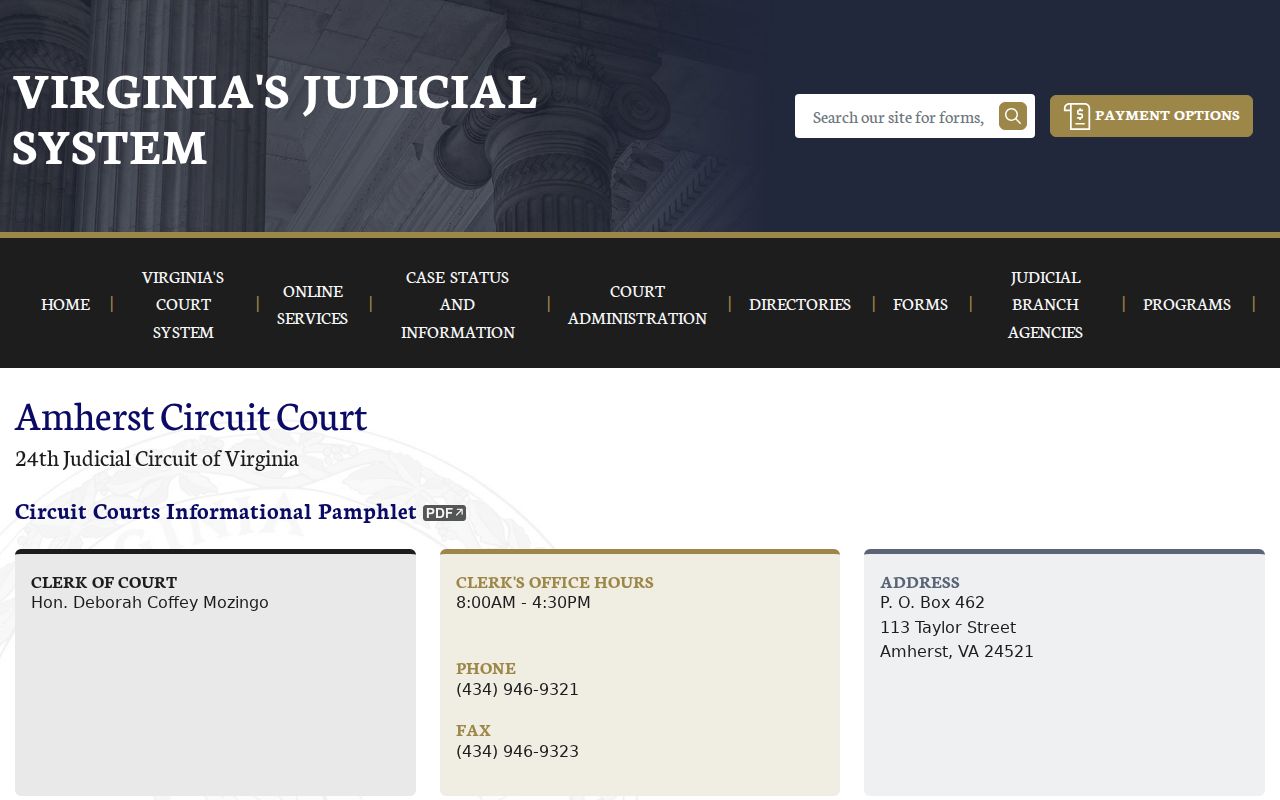
That Circuit route applies to circuit process; a GDC or JDR matter still belongs with its own clerk.
Amherst County FOIA Cannot Change an Order
Amherst County FOIA can seek existing public records such as a policy or a redacted process log. The County FOIA page names Alexandra Doss for county requests and Major J.E. Begley for Sheriff matters. Amherst allows requests by email, mail, fax, phone, or in person and states a five-business-day response period, with possible additional time. Costs reflect actual search and production work.
A public-record request is not a motion to recall a capias. It cannot make the court change a hearing date, remove process, or answer a personal legal question. For an individual case, call the issuing clerk; for a policy or agency log, describe the record type and date range clearly.
Finding the Court That Issued the Warrant
A bench warrant stays tied to the court that set the original case. Amherst Town does not have a separate municipal court, and the County has no JP court in the Virginia structure. Local ordinance and traffic cases go to Amherst GDC. The Sheriff may serve process, but it cannot change the court’s order or schedule.
Use the court name on any paper or case result. If the public display is unclear, call the clerk and ask which office holds the matter and what current step is available. A warrant lookup can help identify the case before that call.
JDR cases have added confidentiality rules. The image links to the official Amherst JDR page; public views do not expose all juvenile and domestic details.
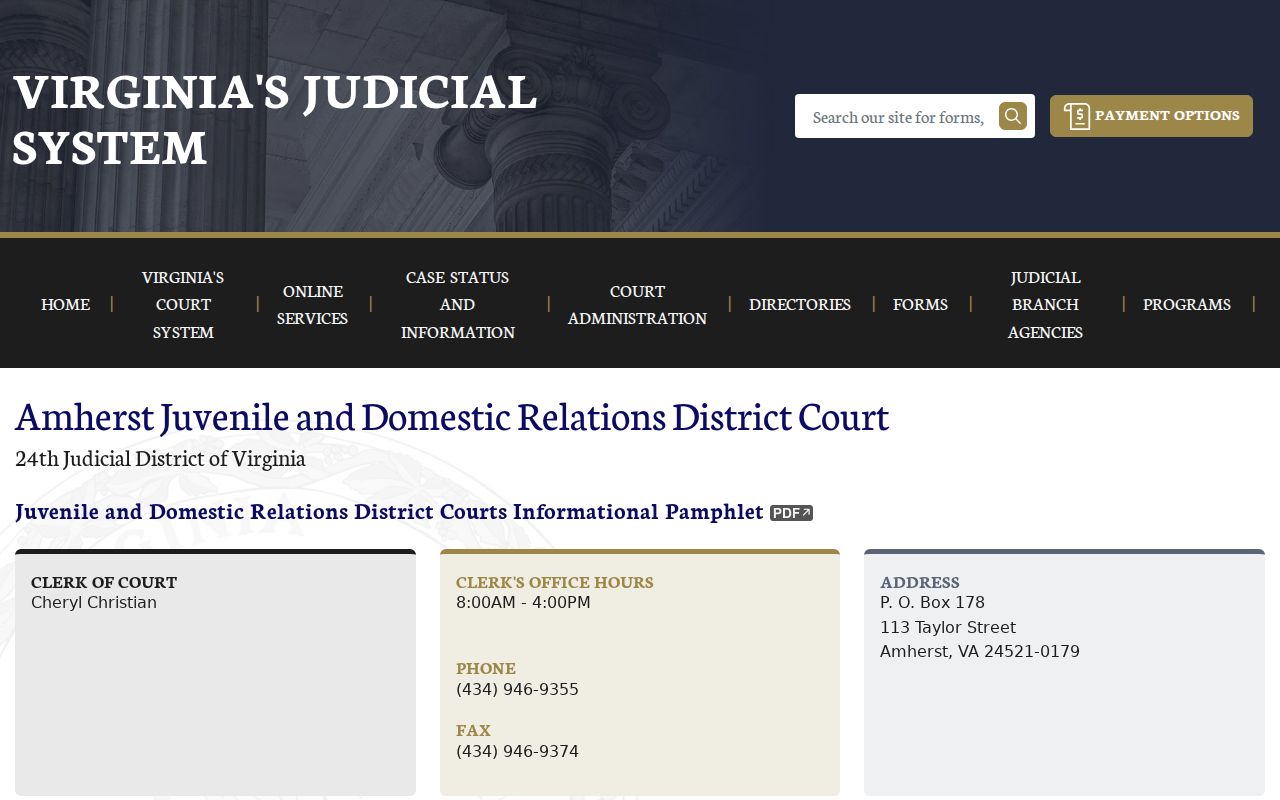
When access is limited, the JDR clerk can explain whether a party-specific route is available.